DECLUTTER, MOTHERHOOD, MOM LIFE, SIMPLIFY, KIDS Fuzzy Hippo Shop DECLUTTER, MOTHERHOOD, MOM LIFE, SIMPLIFY, KIDS Fuzzy Hippo Shop

Decluttering With Your Kids: How To Tackle Common Roadblocks

If there was ever a HOT topic to discuss…it would be decluttering ALL the kids stuff - but more importantly, decluttering WITH your kids! I’ve had parents openly tell me it’s just not possible and that everyone ends up fighting and/or crying. So I’m on a mission to show you that there’s another way and that it IS possible to declutter WITH your kids without a tussle!

Before we layout some strategic steps to decluttering with your kids in your home, let’s get out there all the different roadblocks that might prevent you from decluttering in your home with your kids. Do any of these help you feel seen? No judgement, these are challenges popping up in EVERY home!

A few ways you might see roadblocks decluttering w/ kids surface in your home:

✔️you’re feeling like there’s no time to declutter
✔️you don’t think it’s possible because of the age of your kids
✔️you feeling sentimental about your kids growing up so it’s hard to part with things because you don’t want to let go
✔️you’re not sure how much to hold on to for siblings or future children
✔️you’re overwhelmed with where to start ✔️you don’t know how to initiate it with your kids or how to do it
✔️your kids seem to be overly attached to their stuff ✔️your kids would rather be doing something else and don’t want to do it

….and there’s so much more!

Now that we have some clarity about what might be causing physical or mental roadblocks preventing decluttering from happening in your home with your kids, let’s talk about strategies and solutions!


1. MEET YOUR KIDS WHERE THEY’RE AT.

If you want to start decluttering with your kids, you’ll want to think through where to start. For example, a 2 year cannot declutter an entire library of books on their own. Can they go through 5 books at a time with you and select their favorites? Yes, they can! Can your 5 year old declutter their entire wardrobe by themselves in 10 minutes? Likely not. We’ll dive into more specifics about what might be age appropriate for your kids next, but you can also get the full breakdown on how to do this inside my Parents + Kids Guide to Decluttering. Aim for small goals for decluttering that are realistic for your child’s age, focused around things they enjoy.

2. ADJUST YOUR EXPECTATIONS!

And I want you to really lean into this idea…because trust me, everything will go smoother once you do! If this is the first time you have ever decluttered with your kids and you’d peg them as borderline hoarders, don’t expect much. Much like a muscle your training to do something new, progress takes time. If your kid parts with even one item or is considering parting with something, consider it a win!

Some general guides for kids by age group to start decluttering with them:

Ages: 0-2 / Parents will drive the decluttering for their children. By age 2 you can start talking about clothing they have grown out of. Are those shoes too tight? Do you enjoy looking at this book still? Start weaving these simple concepts into conversations to build on for the future.

Ages: 3-5 / Everyone can take a more active roll in decluttering. Work through small groups of books, toys you see them no longer play with or have developmentally outgrown. They can declutter and remove things they don’t want anymore from their small treasures/junk drawer. Clothing they have outgrown is a quick one to identify. Take note of things they love, have grown out of, that needs to be replaced.

Ages: 6-11 / Beyond keeping their favorites or things that still fit, this is a great time to discuss the cycle of things and how to filter/intentionally bring things in the home. If you have less, you have less to manage and less to be responsible for. There’s also less clean up! Categories of items in short bursts are best to hold attention, like pants, chapter books, sports equipment, activity books, etc. Create categories that make sense for kids and your family. Let them help come up with these categories.

Ages: 12+ / As we build on the concepts from prior age groups, this age range starts to grasp the concept of how things shape their environment. How do they want their room to feel? What would make their closet easier to get dressed from? What do they want to showcase? What do they value? By working with them to answer these questions, it becomes easier to declutter when values are clarified and it’s top of mind. We filter and edit out spaces together to create a home we love and that takes care of us.

See more in depth strategies and details by age group in my Parents + Kids Guide to Decluttering.

3. MAKE THINGS FEEL SMALL TO AVOID OVERWHELM.

Think time, energy and focus. When you have time, even a small chunk, put 10 minutes on the timer and do a short decluttering burst in one drawer or one small category like shoes. Only focus on those things and put blinders on to everything else. Make the process as small and simple as possible. Choose small categories and small zones to declutter.

If you’re struggling to find small categories to declutter (because you’re feeling overwhelmed with all the stuff), create a small group to declutter out of a larger group. For example, if you have a huge book library and you want to start decluttering your stash, choose one shelf, one category of books (like nature books or non-fiction), or by color of the spine (today lets go through all the books with a blue spine only). These strategies will help the process feel ‘small’ and less overwhelming.

4. SHOW RESPECT + VALIDATION FOR YOUR KIDS WHILE DECLUTTERING TOGETHER.

When we do this, we teach our kids to trust themselves and their decisions. This skill will get fine-tuned over time and with practice. If you’re questioning a decision they’re making or they’re on the fence about something, offer to place the item in a holding area that you’ll revisit it in a month. Write it down on the calendar as a reminder to circle back. This will keep you both moving and validated. It’s also OK to ask open ended questions like “tell me why you’re ready to part with this” OR “I see you haven’t worn this in a while, is there a reason you’re hanging on to it?” You might find there’s no fight with the items and it’s easy for them to part with. Be open to the process going smoothly, especially with more practice!

Start communication about things that need to be gone through with more open ended questions that help your kids identify when something is a ‘keep’ and when something is a ‘let go of’ item. Here’s some examples of how their responses might sound in your home:

  • I don’t want this shirt anymore because the sleeves feel itchy.

  • I have other board games that are more fun to play than this one.

  • I’ve read these books 5 times already and I’m ready to move on.

  • My toes are shoved up to the top of my shoes when I’m walking.

  • I really like the color purple right now for clothing and not red.

  • I don’t like wearing skirts to school anymore.

Their reasoning for keeping or parting with something will be raw and straight forward. Do not expect them to use adult logic and don’t force it on them either. Keep the dialog on their terms, in their words and be sure to do more listening than talking!

5. INFUSE FUN INTO YOUR DECLUTTERING!

My favorite thing to do with my kids while decluttering is let them be the DJ and pick the music. If both kids are decluttering, they each get to DJ for 5-10 minute blocks. We also bring in baskets, boxes or bags that the kids can use to put their decluttered items into that turns more into a game where they’re shooting things into a basket! Find ways to have fun along the way, and plan a reward in at the end after progress is made - maybe a trip to get an ice cream or a slush, or money in their piggy bank towards their new shoes their saving up for. Decluttering can become part of family chores/responsibilities in a family economy to learn tangible skills about money (one idea).

Don’t underestimate the value of bringing games into the mix when you’re decluttering! One idea I’ve rigorously tested in my own home is a bowl full of declutter topics to pull from for a few quick bursts of decluttering. Make a list of a few categories like: shoes, books, earrings, fiction books, balls, outdoor toys, etc. Anythings goes! Get creative! Ask your kids what topics should go into the bowl to give them more control. Write topics on a small piece of paper, fold them up and drop them in the bowl. Let one of your kids pick one, put 10 minutes on the timer (and turn on some good music) and go! If you have several kids, they can each taking a turn picking a decluttering topic from the bowl. I promise it’s fun! Have a box or bag ready for them to drop donations in. Find a lot more ideas on different ways to declutter in your home in my Parents + Kids Guide To Decluttering.

But whatever you’re doing, keep it light, keep it fun, maybe add some snacks in too for maximum success! You’ve got this! And make sure to check out even more free resources HERE in our Kids/Family Zone!

P.S. If you’d like to learn ALL the ins and outs of how to declutter with your kids (without the overwhelm + fighting), how to do this by age group, what exactly to say to them to get them decluttering, how to know what to keep and what not to, lots of examples on how to facilitate the process and so much more, please check out my Parents + Kids Guide to Decluttering.

Bonus organizing tips inside + money saving tips in this guide too you’re going to LOVE! I created this digital guide specifically for struggling parents/mamas who want to learn these skills and stop struggling with a chaotic home that’s drowning in kids stuff. It is possible + I can’t wait to show you how to do it HERE! It’s time to have your time, energy + sanity back!

WHAT TO DO NEXT:

+ Check out the KIDS STUFF zone for more free resources!

+ A game-changing resource for families: Parents + Kids Guide to Decluttering is a must for any family!!

+ Click the follow button for @fuzzyhipposhop_kids for more KIDS decluttering tips + basics to get you unstuck in your home on instagram!

+ Download my free declutter guide to get you taking quick + easy decluttering action in your own home (linked in profile).

Read More
DECLUTTER, DONATIONS, MOM LIFE, MOTHERHOOD, ORGANIZE, SEASONAL Fuzzy Hippo Shop DECLUTTER, DONATIONS, MOM LIFE, MOTHERHOOD, ORGANIZE, SEASONAL Fuzzy Hippo Shop

How To Declutter All The Kids Stuff at the End of the School Year

It’s no secret that when school is out (and in the weeks leading up to it) your home can be inundated with papers, artwork, supplies, and random objects far beyond what your home can handle. Today we’re going to break down each category of kids’ school clutter, how to declutter them, then what to do with what you want to keep. And yes, we’re going to discuss how to work with your kids to get them involved in the process so it’s not all on your shoulders! Yep, I’ve got you!

School Papers + School Work.

EDIT: Go through any school papers that came home with your child or have them go through it on their own. My now 8-year-old does this completely on her own. I like to quickly glance through the stack before to scan what’s been going on in her world, then I let her take over the process. Take a few minutes to marvel with them in the stories they wrote, the assignments that were particularly challenging, or things they enjoyed the most. If it feels daunting, set a timer for 10 minutes to keep things moving.

RECYCLE: Anything that doesn’t want to be kept and is paper-based without tape or glue can be recycled.

KEEP: If there are papers you or your child wants to keep, assign them to a folder for a while (ie. give it a clear boundary with a home your child can manage). Revisit this folder in a few months to see if these keep items still need to be kept (often they are ready to part with them sooner than you’d think).

Kids Artwork.

EDIT: Go through the art pieces with your kids or have them go through it on their own. I love having them tell me about their favorites and how each was created. Pull aside the favorites they want to keep and set aside the ones they’re ready to move on from.

RECYCLE: Art made from tapeless origami or watercolors, crayons, colored pencils, and/or markers on paper can all be recycled when no longer wanted. If a piece of artwork has paint, stickers, glue, googly eyes, glitter, popsicle sticks and feathers, it should go in the trash. Are there plastic pieces? Foam stickers? These are all things that cannot be recycled, and shouldn't be placed in the recycling bin even if they are attached to paper or cardboard. See addition kids art recycle and toss tips HERE.

KEEP: Artwork that your child wants to keep can be saved in a few ways. 1) Displayed in the home in frames or pinned up in any way you choose. We rotate out artwork each season or every few months n frames on an art ledge. 2). Have a keep folder (like the papers) to save for a while and revisit later. 3) Make it into something else, like a card for a friend’s birthday or gift wrap for a grandparent. 4) Take digital photos of their favorite art pieces and create a printed photo books each school year, semester, or whatever timeframe works best for you. I love how Holly Blakey creates art books for her kids using this technique. Alison Mazurek also has the best space saving suggestions related to kids artwork and saving here. I hope to get more diligent with this in our own home, so I’ll keep you posted on my progress soon!


School Supplies.

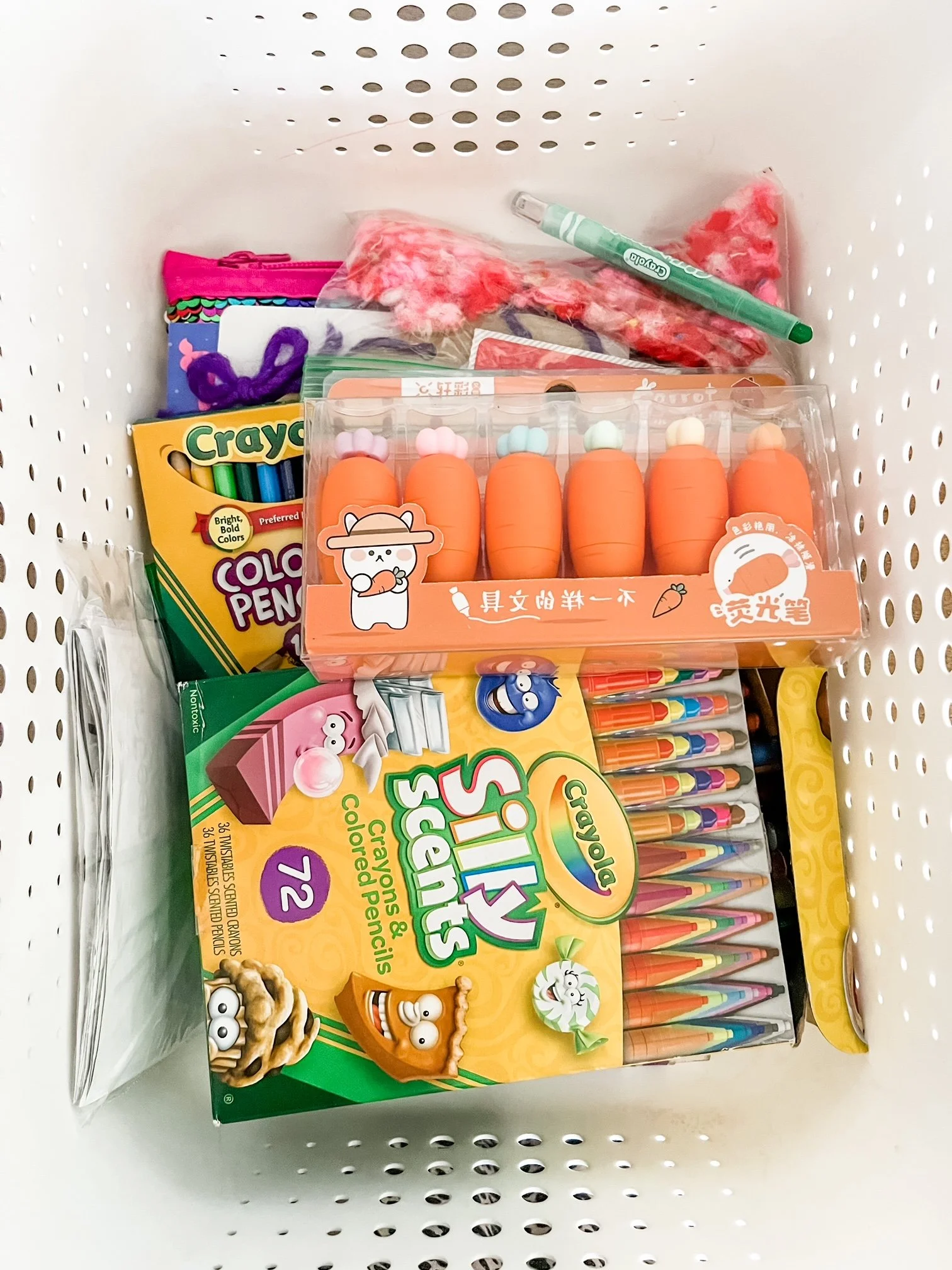
EDIT: Before you start chunking things in the trash, look at all that has come home with the filter of “could we use this again next year or someone else?” Over the last several years, we’ve been able to reuse several things from year to year. From backpacks, lunch bags, notebooks, plastic folders, dividers, to pencil cases, crayons, colored pencils, pencils, some unused notebooks, pens, erasers, etc. All the sudden your bill for school supplies next year doesn’t seem so high!

RECYCLE: Extra paper boxes and bulky packaging that’s no longer needed can be recycled so they don’t take up as much space. Reuse or donate anything in good shape that is no longer needed or you have duplicates of, from books, to writing utensils, extra paper, notebooks, rulers, etc. Full notebooks that have been used up as journals or for notes can be recycled if they are without tapes, glues, stickers, etc. These extras can also be offered up to local schools and charities to support teachers and students with school supplies needs. Check out all my donation links under schools and teachers here for more ideas.

KEEP: If you have school supplies you anticipate using again for next year, I would encourage you to pull them aside in a bag or container and label it. One of my age old tricks is to remove any permanent marker from notebooks and plastic folders with a damp Mr. Clean Magic Eraser. If you’re trying to remove any labels or stickers on most plastics or non-paper surfaces, it will easily come off with some drops of lemon oil rubbed on it for a few minutes. Wipe the area clean with water and dry off completely once the label or sticker has been removed.

Random Toys + Misc Objects.

EDIT: Before you start editing, talk together with your kids about where these fun “extras” are going to live in your home. Give them a clear boundary or two so they have a home for the toys/extras so can be easily returned there. Pull everything out onto a table or flat surface to go through it. Identify what’s trash, recycle, donate and keep items. Discuss limiting duplicates, things that broken or no longer loved. With a clean boundary (like a basket or a drawer) it will be clear how much can be kept moving forward.

RECYCLE: Paper-based items, cards, boxes, notes, etc. can make their way to recycling if they’re not longer being kept. Check on what plastics your area accepts locally. Consider toys in good shape that could be given away/donated/sold and pull those aside for donations. If it is a cheap plastic toy that will break in two seconds, it’s best to send it directly into the trash. You can also offer up a box of toys or kids decor freebies to a local Buy Nothing Group or share to your area on Freecycle for others to enjoy.

KEEP: With the newly establish boundary for your child’s random keep items, help them organize what they have and discuss how to filter what comes into your home in the future. For example, group items by sizes and how it is used/by type for example. Ask them questions about what they enjoy playing with or what they enjoy having around the most to help them focus on what they should allow into the home in the future. This editing and organizing process will also give them clarity on what they already own. Discuss that once this “boundary” is full or feeling disorganized (they’re digging around, can’t find things or the drawer won’t shut for example) it’s a red flag to take some time to go through and edit what’s in there. They can ask for your help or go through it on their own. Practice over time will make this process easier and smoother, promise!

Are there any other kids “school clutter” that I missed or you want me to talk more about? Make sure to drop it down below in the comments. Now tell me, have you tamed the school clutter yet in your home this summer? Tell me everything in the comments below!

Want to get this decluttering party with your kids + need more help getting started? Here’s a few options for you to get you moving + motivated.

Parents + Kids Guide to Decluttering

The biggest game changer to make decluttering in your home with a family less chaotic + more peaceful!

Free Declutter Guide, Learn the basics of Decluttering, Schedule Decluttering Support, Donate Your Decluttered Items For Good Links

Read More
DECLUTTER, ORGANIZE, MOM LIFE, SEASONAL Fuzzy Hippo Shop DECLUTTER, ORGANIZE, MOM LIFE, SEASONAL Fuzzy Hippo Shop

How To Do A Spring Declutter On Kids Toys

The dust has settled on the new year and we’ve all moved into a new routines. By now you know a bit more about the things that walked in the door at the end of last year. Some are being enjoyed and others are just creating unnecessary clutter and work for you. Since we are right on the cusp of Spring (even if the weather doesn’t quite feel like it where you are) this is the perfect time to reset your home from the toy clutter that’s accumulated since the new year. Here’s 3 steps to help you do a solid decluttering on your kids toys as we move into Spring (or anytime)!

Toys can mean anything your kids are playing and engaging with. Cast the net as wide or as narrow as you’d like to declutter.

1. Observe what they’re playing with.

This includes anything you consider “toys” in your home or fosters play, problem solving and creating. Think sports equipment, outdoor toys, bath toys, books, building sets, random “treasures”, rock collections, crafting supplies, stuffies, games, etc. I bet off the top of your head you’ll be able to identify several things you haven’t see your kids touch in months (if not longer) or have outgrown. In this phase of Spring toy decluttering, we’re merely taking note of what you’re seeing going on in your home to help you in the next step.

Bonus Tips:

To confirm your suspicions about what your kids are or aren’t playing with, ask them about what their favorites are (if age appropriate). Talk to your kids about things you never see them use and discuss whether to keep it or not. Move things around to draw more attention to items you suspect they enjoy but might have forgotten about because of where they are stored (out of sight). Use this as a benchmark for which items to keep while you’re observing what they’re naturally gravitating towards.

2. Do a thorough edit involving your kids.

You can tackle this in a few different ways. One, by a single category at a time. For example, edit all books, all building toys, all bouncy balls, all board games, dress up items, etc. Individual categories help you focus on one group of things at a time. Two, you can also edit by zone in your home. Toys in the bedroom, the primary play area, the toy chest, etc. Focusing on a certain zone in your home allows you to start and complete one area before moving on to another. However you want to do this is the right way to do it for you. In both of these options, you can break down the process into small chunks, as you can get to it with your schedule. Your kids will also stay more focused for a Spring decluttering on toys in small bursts of time. Correct, no clearing your schedule for a toy edit! Ain’t nobody got time for that!

Bonus Tips:

Involve your kids in whatever what you are able and feel comfortable. Age will steer conversations and the level of involvement. Take this decluttering time with your kids to ask questions, to listen and learn about what they’re enjoying most at this time. It is a time of connection and learning together. Ask what they enjoy most out of a group of book OR which are your favorite books you love reading over and over again? Ask directly “which items do you no longer enjoy?” Involve them in the donation, recycling, and giveaway process. Talk about what is trash versus something you can repair and keep. These are all just jumping off points on how to start. You know your child best and I know you’ll come up with some great ideas on decluttering together that is age appropriate. If you’re child is too young to involve, focus on toys they’ve outgrown, are developmental appropriate, safety and what activities you want encourage. Avoid toys that do all the work for your kids - focus on keeping toys that can be reinvented over and over again into different things depending on how they want to play in that moment.


One thing that has always been important in our home is to make drawing, art and creating accessible. We intentionally keep paper and drawing supplies out on one end of our table at all times and it gets used every single day!

3. Make it easy for play to happen.

After you’ve completed your Spring toy decluttering on any and all of the toys and play/create things, assess what you’ve decided to keep. Take a moment to make sure to set up clear zones for play to happen easily in your home. Not everything has to be out at one time, but items should be easily accessed by the kids as it makes sense for your space. Lesser used items can be tucked away, up high or in a spot adults can help with if it needs more supervision or more time to set up. Keep their favorites easy to access. If you want to encourage more reading or for that untouched bead set to be used, make it easy to see and reach for.

Bonus Tips:

During the Spring season, continue to take note of what they’re enjoying and what they’re outgrowing. Decluttering is an on-going process for all of us and this idea is highlighted the most with kids. They grow and change in the blink of an eye. Taking the time to filter what comes in, care for what is in the home, and being resourceful with what is kept is a must. When they’re asking for new things or to buy something with their piggy bank money, ask helpful questions to guide their decisions making like: where will this item go in the home, do you have anything like this already, how will you use this or play with it, how will you take of it, how much space will it take up and is that worth it to you, etc. While your child will still make the decision, these are questions they should learn to have in the mind before bringing new things into the home. Yes, it gets easier for you and them with practice!

NOTE: Adults need to comb through all these tools in our mind as well to help filter what we bring into the home. We model what we want to teach to our kids and decluttering is a powerful medium to share and learn with our kids over and over again.

A few organizing tips:

Once you’ve identified all your toy “keeps”, use this list as a go by when you’re finding homes for things + getting reorganized:

  • Try to store things where they will be used a much as possible, or where it would be the most convenient to access them

  • Make sure the main users (kids) can safely access things you want them to

  • Keep sometimes toys or items that need adult support away from the main play zones

  • Organize items by type and by size (building, books, kitchen toys, dress up, etc.)

  • Big items need a big shelf or bin / Smaller items need smaller containers to store them - when they get mixed is when you dig and lose things!

  • Not everything needs to be out at one time / consider rotating things around as needed / less out reduces overwhelm (where they choose nothing) and fosters more creativity

  • If you want to encourage more play with a particular thing, put in an obvious, easy to access space / move things around until you get the results you’re after

  • The size of your space or zone detemines how much you’ll have out. If something needs to be tucked away or pulled out, make sure it’s in an easy to reach spot so things don’t get forgotten/ignored.

  • Encourage easy clean up by making it simple and intuitive for your kids to do it on their own - but make sure to teach them what to do, what the expectations are and follow up!

  • The best “toy” you can offer your kids is open space to play, create, learn and breathe! Aim for less whenever possible.

Want more support decluttering all things kids?

Declutter Guide for Kids

See all Declutter Tools + Guides

Let me know how I can support you in your home.

Drop your comments below. Thanks for being here!

Read More